
Configlitch
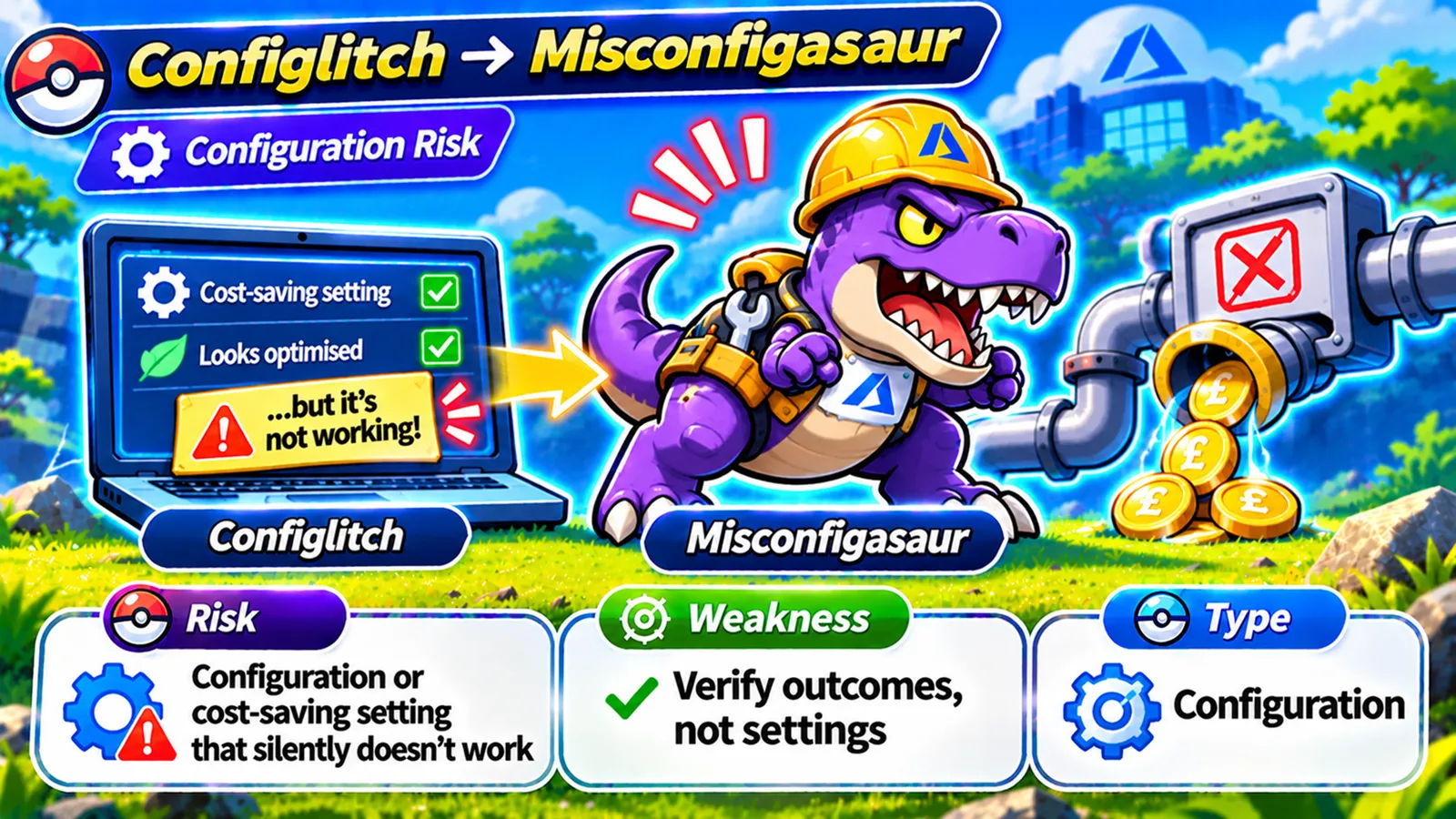
- Type
- Configuration
- Anomaly
- Cost-saving setting that silently doesn't work
- Evolves into
- Misconfigasaur
- Weakness
- Verify outcomes, not settings
What it is
Configlitch feeds on false confidence. A setting that should reduce cost (retention, tiering, auto-shutdown, capping, lifecycle rule) is configured but doesn't take effect, so cost doesn't fall and nobody notices.
How to spot it
- The expected saving never shows up in Cost Analysis.
- Data volumes or running hours don't match the configured policy.
- The setting looks correct in the portal or IaC, but behaviour differs.
Common causes
- Policy scoped to the wrong resources, or overridden elsewhere.
- Features that need extra prerequisites or only apply to new data.
- Drift between IaC and deployed state.
- Misunderstood semantics (e.g. cap vs. alert, retention vs. archive).
Evolution: Misconfigasaur
Multiple silently broken settings across an estate leave a large gap between assumed and actual spend.
Defences
- Verify outcomes, not settings: confirm cost, size or runtime actually changed.
- Add checks comparing expected vs. actual after rollout.
- Detect drift; document the intended effect of each cost-saving control.
Real world encounter
The encounter
A customer migrates databases from on premises to Azure SQL PaaS using a template deployment. Once everything is up and running, the cost is higher than they expected. But everything works, so they put it down to an estimating error and accept it as the new normal.
Tracking it down
Nobody investigated until a later review compared actual cost to the original estimate. Looking at the database SKUs showed every dev and test database was the same size as production. The template hadn't parameterised the database size, so all environments were deployed at the production value. The setting that decides whether a database is cheap or expensive was not set to what anyone thought it was.
Catching it
The template was updated with a size parameter per environment, and the non-production databases were scaled down. The team documented the expected cost per environment and compared it to actuals after each deployment.
The lesson
Configlitch is a setting that silently doesn't do what you assume. When cost isn't what you expect, don't blindly accept it: review, validate and explain the difference, and capture what you learned. Set a FinOps scope before a migration starts so you can track real spend against expectations as it grows, and regularly look for oversized resources.