
Promptle
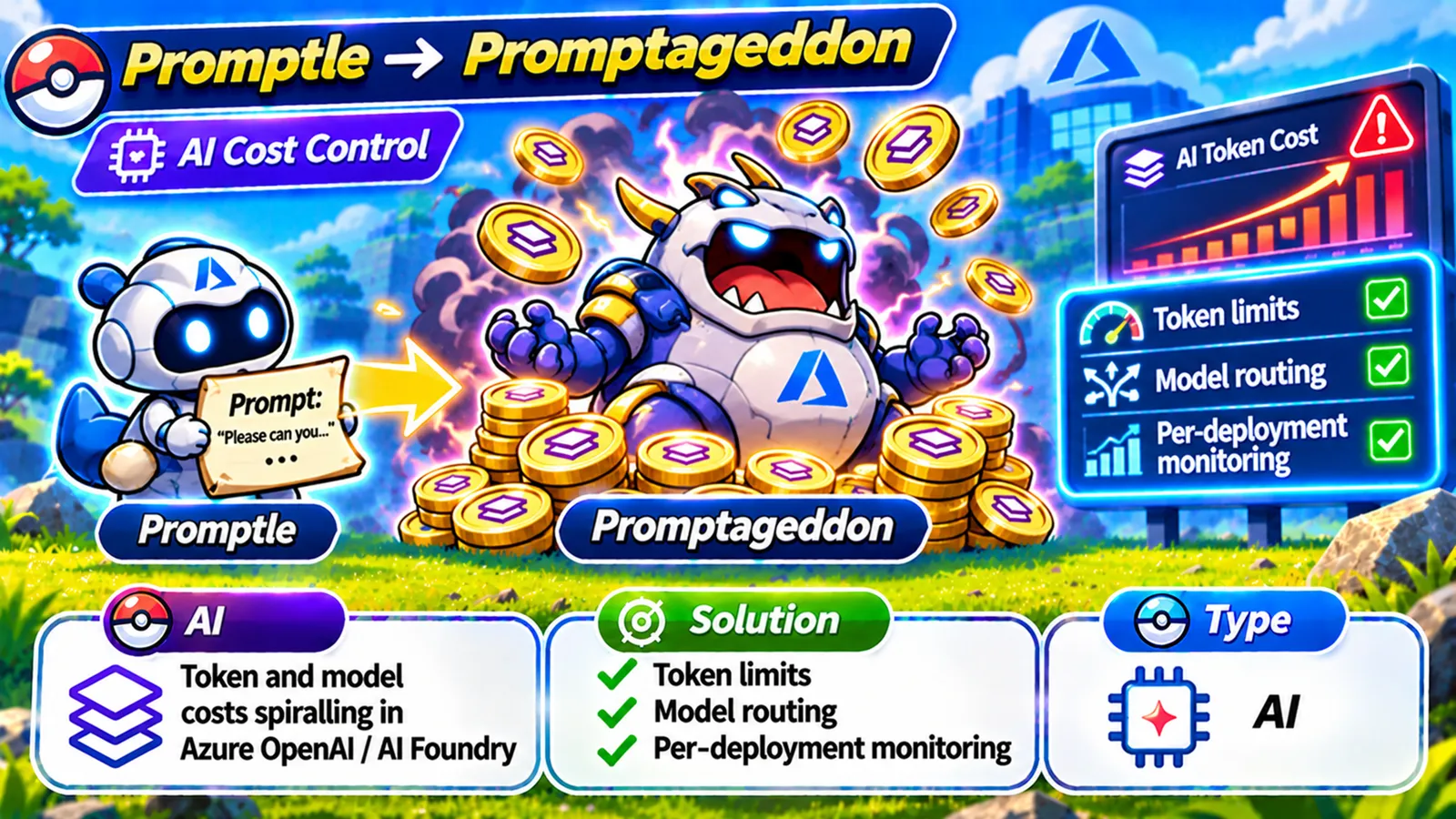
- Type
- AI
- Anomaly
- Token and model costs spiralling in Azure OpenAI / AI Foundry
- Evolves into
- Promptageddon
- Weakness
- Token limits, model routing, per-deployment monitoring
What it is
Promptle thrives on tokens. Azure OpenAI / AI Foundry is billed per token (or provisioned throughput), so long prompts, big context windows, premium models and chatty agents can multiply cost rapidly.
How to spot it
- Cost rising per deployment or model in Cost Analysis.
- Token metrics (prompt vs. completion) growing faster than user numbers.
- Agents or RAG pipelines making many calls per user request.
Common causes
- Expensive models used for simple tasks.
- Oversized prompts, unbounded chat history, too many RAG chunks.
- Agent loops and retries; no
max_tokenslimits. - Provisioned throughput (PTU) over-allocated or idle.
Evolution: Promptageddon
Agentic workflows and multi-model pipelines compound calls and context, driving cost far beyond forecasts.
Defences
- Token limits (
max_tokens, quotas, rate limits, APIM token-limit policy). - Model routing to cheaper models where quality allows.
- Per-deployment monitoring and alerts; track cost per outcome.
- Prompt caching and context trimming.
Real world encounter
The encounter
A customer is experimenting with AI and builds a proof of concept agent that processes data and runs background jobs. They kick off a batch of big jobs and leave them running without monitoring cost or token usage. A few days later the Azure bill arrives and the proof of concept has cost more than 20k.
Tracking it down
In Cost Analysis, spend grouped by resource points to a single Azure OpenAI / AI Foundry deployment. Token metrics showed prompt and completion tokens far beyond anything expected for a PoC, driven by large prompts and an agent making many calls per job. There was no token limit and no monitoring, so nothing slowed it down.
A different customer enabled Copilot consumption and gave access to lots of users. Everyone started doing useful things with it, which was exactly the point, but the bill showed hundreds of dollars a day that nobody had planned for.
Catching it
The team sandboxed the PoC, set token limits and a usage cap where possible, and added token monitoring using OpenTelemetry. For Copilot, they trialled with a small group first to understand how real user behaviour drives cost before widening access. A tight FinOps scope was put around each high-risk AI use case.
The lesson
Promptle thrives on tokens. When you adopt something new, understand how its costs work before you start, and how user behaviour affects them in the real world. Sandbox the risk, cap usage, make people aware this is a high-risk area, and look at commitments once usage is large and predictable.