
Orphanite
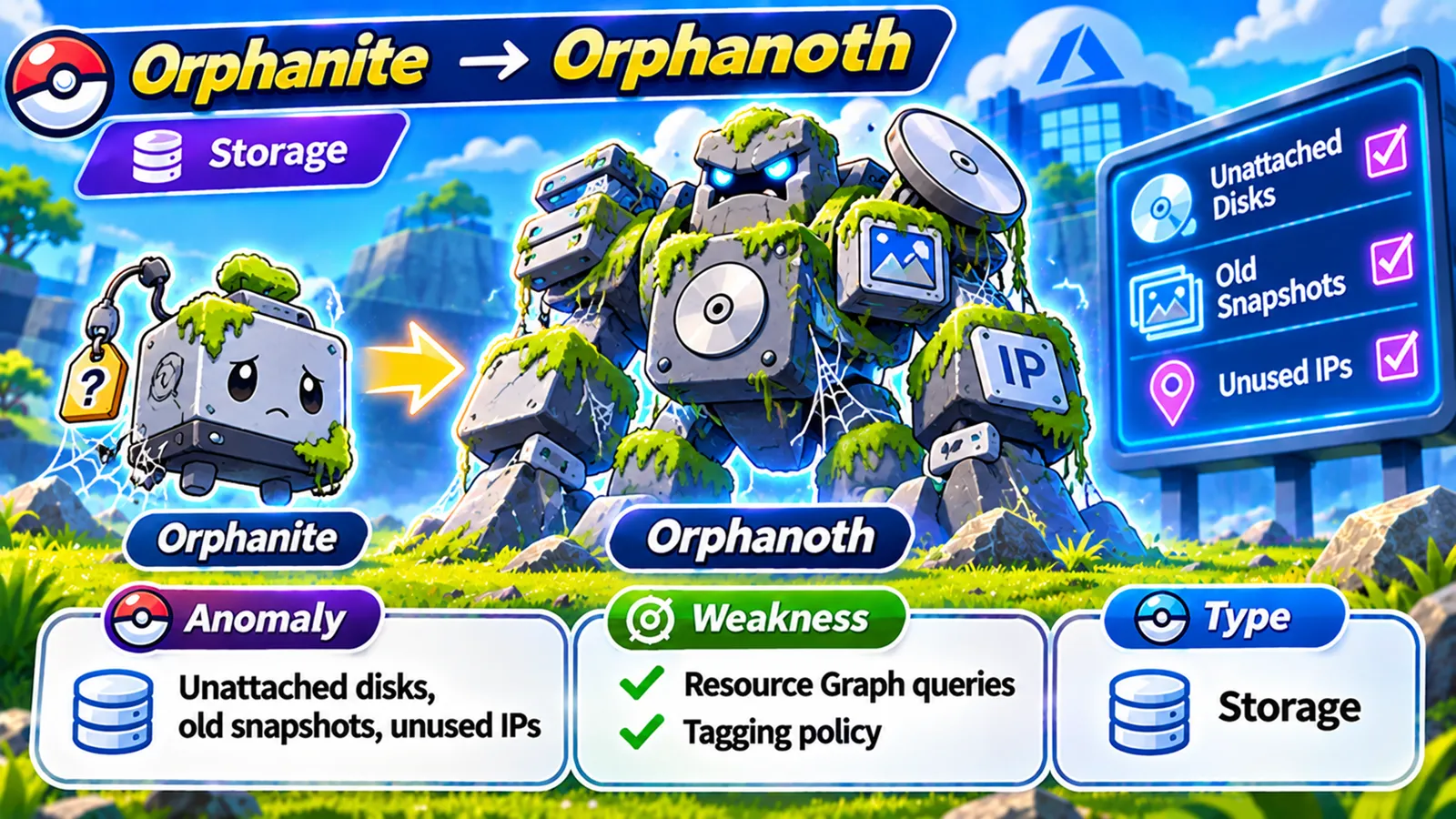
- Type
- Storage
- Anomaly
- Unattached disks, old snapshots, unused IPs
- Evolves into
- Orphanoth
- Weakness
- Resource Graph queries, tagging policy
What it is
Orphanite grows from leftovers. When VMs and workloads are deleted, their disks, snapshots, public IPs and NICs often remain and keep billing quietly.
How to spot it
- Managed disks with no
managedBy(unattached). - Snapshots far older than any retention policy.
- Public IPs not associated with a NIC or load balancer.
- Slow, steady cost that never drops after decommissioning.
Common causes
- Manual deletion of VMs without cleaning up dependents.
- No lifecycle or ownership for snapshots and backups.
- Failed or abandoned deployments.
Evolution: Orphanoth
Across many subscriptions, years of orphaned resources add up to significant recurring waste.
Defences
- Azure Resource Graph queries to find unattached disks, old snapshots and idle IPs.
- Tagging policy (owner, expiry) enforced with Azure Policy.
- Scheduled cleanup reviews; Azure Advisor recommendations.
Real world encounter
The encounter
A customer decommissions an application. The project is closed, the team celebrates and the application is gone. The expectation is that its cost will drop to zero. It doesn't. The bill falls, but not as far as planned, and because the application was only a small part of a much larger organisational cost, nobody checks.
Tracking it down
A later review of idle resources highlights a significant number of managed disks not attached to any VM. They were left behind when the VMs were deleted. A Resource Graph query for disks with no owning VM finds them all, and old snapshots and unused public IPs turn up alongside them. It was technical debt nobody noticed, because the cost sat quietly inside a large total.
Catching it
The orphaned resources were reviewed and deleted. For future decommissions, a FinOps scope is created around the resources being retired so cost can be tracked as it declines toward zero. If it stops short of zero, something has been left behind.
The lesson
Orphanite is the opposite of a spike: a floor that doesn't fall. Decommissioning isn't finished when the application stops, it's finished when the cost reaches zero. Regular idle and unused resource reviews catch what individual projects miss.